
Article: Hair Loss in Men: Causes and What to Do
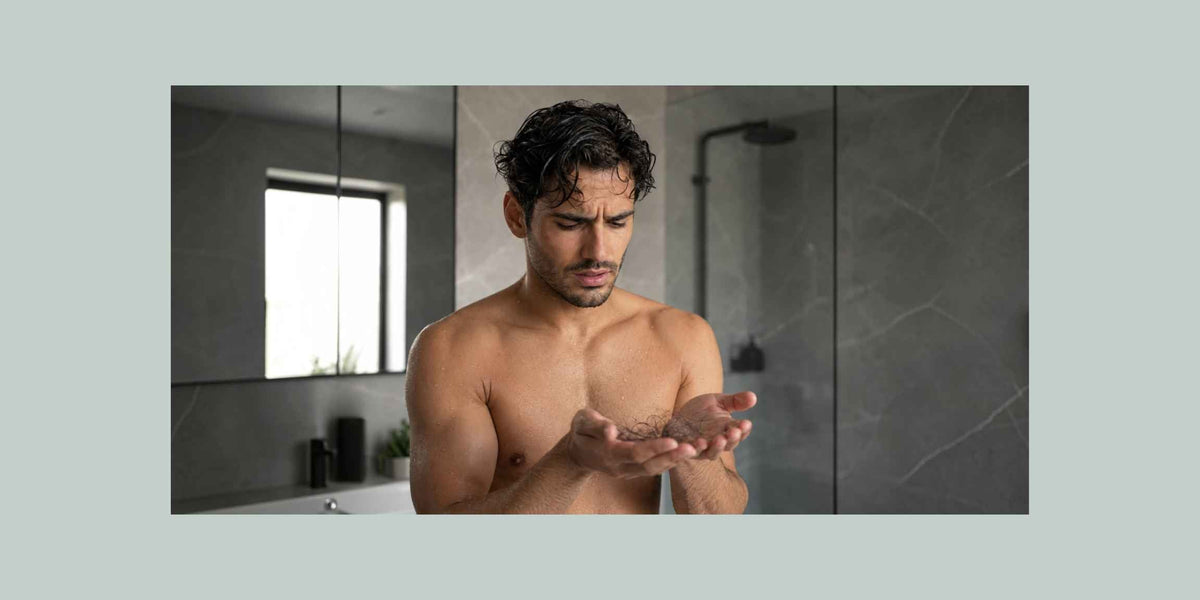
Hair Loss in Men: Causes and What to Do
Hair loss in men rarely has a single cause. It may form part of the hair’s natural growth cycle, be linked to genetic predisposition, appear after periods of stress or illness, or manifest as progressive weakening and breakage of the hair fibre.
Before looking at how to reduce hair loss, it is therefore essential to identify what is actually happening: shedding from the root, a progressive loss of density, breakage along the hair shaft or an imbalance of the scalp.
Androgenetic alopecia is the most common cause of progressive hair loss in men. However, hair loss can take different forms, and each may call for a different approach. Identifying the cause and taking action at an early stage becomes particularly important once the loss of density begins to appear visible.
Hair loss in men: the essentials
Male hair loss may be influenced by genetic, hormonal, seasonal, nutritional or emotional factors, as well as by the condition of the scalp and the hair fibre.
An advanced hair care routine, formulated to act on both the scalp and the fibre, allows the principal signs of weakened hair to be addressed:
- Maintaining a clean, balanced and well-cared-for scalp.
- Reinforcing the hair against breakage.
- Improving its strength, body and overall appearance.
- Promoting greater density and volume.
The key lies in a complete and consistent strategy: maintaining the scalp in optimal condition, reinforcing the structure of the hair and delivering targeted actives to improve its strength, density and volume.
Is it normal to lose hair?
Hair passes through different phases of growth, transition and rest. At the end of its cycle, the hair naturally sheds to make way for new growth.

For this reason, noticing hair in the shower, on a comb or on the pillow does not necessarily indicate alopecia. Rather than attempting to count every strand, it is more useful to observe whether there are visible changes compared with the hair’s usual condition.
The most relevant signs include:
- Greater visibility of the scalp.
- Reduced density at the crown.
- A progressive recession of the frontal hairline.
- Increasingly pronounced temples.
- A reduction in hair diameter.
- Sudden shedding or hair loss that is clearly greater than usual.
- The appearance of visibly sparse or hairless areas.
Hair loss, weakening and breakage are not the same
Although these terms are often used interchangeably, they describe different processes.
| Condition | What happens | Typical signs | Recommended response |
|---|---|---|---|
| Natural shedding | The hair reaches the end of its growth cycle | Complete strands and stable density | Observation and regular care |
| Breakage | The hair fibre snaps | Short hairs and irregular lengths | Reinforce the fibre and reduce external stress |
| Weakening | The diameter of the hair decreases | Less body, strength and volume | A strengthening hair care routine |
| Progressive alopecia | Follicular miniaturisation occurs | Temples or crown become increasingly visible | A targeted hair care strategy and ongoing assessment |
Hair shedding
The hair detaches from the follicle. The complete strand may be visible, sometimes with a small bulb-like end at the base.

Shedding may progress gradually, as commonly occurs with androgenetic alopecia, or appear in a more diffuse and sudden form.
Hair weakening
The hair continues to grow, but becomes progressively finer, more fragile or less resistant. As a result, the overall appearance of the hair may lose body and visual density.

In androgenetic alopecia, certain follicles that are sensitive to androgens begin to produce progressively finer hairs through a process known as follicular miniaturisation.
Breakage of the hair fibre
The hair does not necessarily detach from the root. Instead, it breaks along the length of the fibre.
This may be associated with friction, high temperatures, certain chemical processes, aggressive brushing or a particularly fragile hair fibre.

This distinction is important because a high-performance strengthening formula acts directly on the quality of the fibre: improving its cohesion, increasing its resistance to breakage and helping the hair retain greater body, uniformity and visual density.
The main causes of hair loss in men
1. Genetic predisposition and androgenetic alopecia
Androgenetic alopecia, also known as male pattern hair loss, is the most common cause of progressive hair loss in men.
It often begins with a recession of the frontal hairline, the development of more pronounced temples or a reduction in density at the crown. It may begin in early adulthood and progress gradually over many years.
It is associated with a genetic sensitivity of certain follicles to dihydrotestosterone, or DHT. This sensitivity may shorten the growth phase and lead to the production of progressively finer hairs.
2. Physical or emotional stress
Periods of intense stress, insufficient rest, surgical procedures, high fever or certain illnesses may temporarily disrupt the hair growth cycle.

Hair loss does not always appear immediately. In some cases, it may become noticeable several weeks or months after the triggering event.
When a large number of hairs enter the resting phase simultaneously, a diffuse form of shedding known as telogen effluvium may occur. It does not usually follow the temple-and-crown pattern associated with androgenetic alopecia.
3. Diet and nutritional deficiencies
Hair requires proteins, vitamins, minerals and energy in order to maintain its growth.

A highly restrictive diet, rapid weight loss or specific nutritional deficiencies may affect the hair cycle. However, taking supplements without knowing whether a deficiency is present is not necessarily beneficial. Excessive levels of certain nutrients may also contribute to hair loss.
4. Scalp imbalances
Itching, redness, flaking, excess oil, sensitivity or an accumulation of residue may indicate that the scalp is not in balance.
These conditions are not necessarily the cause of androgenetic alopecia, but they may compromise comfort, make daily care more difficult and affect the overall appearance of the hair.
The scalp is skin. It therefore requires regular cleansing and formulas adapted to its specific characteristics, just as the skin of the face does.
5. Breakage and external stress
Excessive heat, vigorous towel drying, aggressive brushing, overly tight hairstyles and certain chemical processes may weaken the hair fibre.
When the hair is already fine or weakened, these practices may increase breakage and reduce its visual density even further.
6. Age and the natural evolution of the hair
Over time, hair growth may slow. The hair may lose diameter, pigmentation and density, even in the absence of a clearly diagnosed form of alopecia.
This does not mean that every man will experience hair loss in the same way. Genetics, general health, lifestyle and the quality of hair care all influence how the hair evolves.
How can you tell whether your hair is beginning to weaken?
Hair weakening usually develops gradually, which can make the early signs difficult to identify.
It is worth observing:
- Whether the hair appears finer than before.
- Whether it has lost body or volume.
- Whether the hairstyle reveals more of the scalp.
- Whether the crown appears less covered.
- Whether the temples are becoming more pronounced.
- Whether breakage is becoming more frequent.
- Whether the hair becomes oily or falls flat more easily.
- Whether persistent itching, flaking or sensitivity is present.
Comparing photographs taken in the same light and from the same angle may be more useful than examining the hair in the mirror every day.
The importance of the scalp in men’s hair care
Hair grows from the scalp. For this reason, a complete hair care strategy should never focus exclusively on the visible lengths.
The scalp accumulates sebum, perspiration, surface cells, environmental pollutants and styling residue. Appropriate cleansing removes these substances without unnecessarily compromising the skin’s comfort.
The objective is not to cleanse more aggressively, but to cleanse with precision.
A well-designed hair care formula should maintain the balance between:
- Cleansing performance.
- Scalp tolerance.
- Care of the hair fibre.
- Ease of rinsing.
- A lightweight feel.
- The absence of residue that may weigh the hair down.
Does washing your hair every day cause hair loss?
Washing does not, in itself, cause healthy hair to fall.
The hairs seen in the shower are often already at the end of their growth cycle and detach during massage or rinsing. Excessively reducing washing frequency out of concern about shedding may encourage the accumulation of oil and residue.

There is no single washing frequency that is suitable for every man. Hair may be washed whenever the scalp requires it, provided that an appropriate formula is used and excessively hot water, intense friction and overly vigorous massage are avoided.
An oily scalp may require more frequent washing than a dry or sensitive scalp.
What does a men’s anti-hair loss shampoo actually do?
An anti-hair loss shampoo forms the first technical step in an effective hair care strategy. Its formulation determines the quality of cleansing, the balance of the scalp and the preparation of the fibre for the treatment that follows.
A high-performance anti-hair loss shampoo should deliver a complete action:
- Cleanse the hair and scalp.
- Remove excess oil, perspiration and residue.
- Support the scalp environment.
- Help reinforce the hair fibre.
- Improve resistance to breakage.
- Add body and volume.
- Prepare the hair and scalp for the subsequent treatment.
Its value lies in its ability to cleanse with precision without compromising the scalp’s natural balance, remove excess sebum without stripping the hair, reinforce the fibre and leave the hair feeling stronger, fuller and lighter from the very first step of the routine.
What are the benefits of a hair density serum?
A hair serum allows a concentrated formula to be applied directly to the scalp and hair fibre, where it remains in contact for longer than a rinse-off product.
A concentrated, expertly developed formula acts specifically to:
- Reinforce the structure of the hair fibre.
- Increase the hair’s resistance to breakage.
- Enhance volume and density.
- Extend and intensify the strengthening action initiated during cleansing.
- Revitalise the scalp and improve its balance.
- Provide high-performance hydration without leaving an oily residue.
Consistency is essential. Hair care should be approached as a continuous system rather than an isolated application.
How to build a routine for weakened hair
Step 1. Use an anti-hair loss shampoo
The shampoo should be applied primarily to the scalp.
A gentle massage with the fingertips helps distribute the formula without scratching or creating excessive friction. During rinsing, the product moves through the rest of the hair and cleanses the lengths without the need for vigorous rubbing.
Step 2. Apply the treatment to the scalp and hair
After washing, the serum should be applied precisely to the scalp and distributed through the hair, concentrating the formula on areas where weakening or loss of density is most visible.
A gentle massage helps distribute the product evenly. There is no need to press firmly: the objective is precise application, not intense friction.
Step 3. Reduce breakage
After washing:
- Do not twist the hair in a towel.
- Remove excess water using gentle pressure.
- Use the hair dryer at a reasonable distance.
- Avoid extreme temperatures.
- Brush without pulling or tugging.
- Remove styling products thoroughly.
Step 4. Maintain consistency
Hair responds according to slow biological cycles. Continued use of the system therefore allows its actives to work cumulatively on both the scalp and the hair fibre.
Consistency, precise application and realistic expectations are all part of an advanced hair care strategy.
DENSEL Hair System: acting on the scalp and the hair fibre
DENSEL Hair System is the advanced men’s hair care line by HOMO NATURALS, developed to act simultaneously on the scalp and the hair fibre. Its technology combines high-performance botanical actives, proteins, amino acids, hyaluronic acid and ferments to combat weakening, reinforce the hair and visibly increase its strength, density and volume.
The system delivers two consecutive, complementary actions: a sulphate-free strengthening cleanse that balances and prepares the scalp, followed by a concentrated treatment that revitalises, reinforces and densifies the hair fibre.
1. DENSEL Strengthening Anti-Hair Loss Shampoo
Its sulphate-free technology removes excess sebum and impurities while preserving the scalp’s natural balance.
The formula combines aloe vera, rosemary, peppermint, green tea, saw palmetto, amaranth, proteins and amino acids to stimulate the scalp, reinforce the fibre and improve the hair’s resistance to breakage.
Castor oil, shea butter and plant-derived conditioning agents nourish and hydrate without weighing the hair down, while Zea mays starch helps absorb excess oil and prolongs the feeling of lightness.

2. DENSEL Hair Density Serum
Its concentrated formula acts on both the scalp and the hair fibre to reinforce the hair from within its structure and increase its density.
The protein and amino acid complex improves fibre cohesion and resistance; amaranth and green tea provide strengthening and antioxidant benefits; hyaluronic acid helps preserve hydration; while botanical ferments, rosemary and peppermint revitalise the scalp.
The result is hair with visibly greater volume, strength and density.
Both formulas have been designed to perform as a two-step anti-hair loss treatment: purifying, balancing and strengthening during cleansing; then revitalising, reinforcing and densifying through the directly applied serum.

How to respond to the first signs of hair weakening
A progressive reduction in hair diameter, strength or density is among the most common signs of male hair weakening. Acting early with a targeted routine helps care for the scalp, reinforce the fibre and improve both the quality and the appearance of the hair.
Some signs, however, fall outside this typical progressive pattern. A specialist assessment may be advisable when the hair loss:
- Appears suddenly or becomes unusually intense.
- Is concentrated in circular or clearly defined patches.
- Is accompanied by pain, burning, severe itching or persistent sensitivity.
- Occurs alongside redness, inflammation, lesions, crusting or marked flaking.
- Also affects the eyebrows, beard or other areas of the body.
Correctly identifying the type of hair loss allows for a more precise strategy. In cases of progressive weakening, reduced body or lower visual density, an advanced and consistent hair care routine forms the foundation of treatment. When sudden, localised changes or persistent scalp discomfort appear, it is advisable to complement this routine with a professional assessment.
Frequently asked questions about hair loss in men
Why do men lose their hair?
The most common causes include genetic predisposition, hormonal sensitivity of the follicles, stress, certain illnesses, some medications, nutritional deficiencies and disruptions to the hair cycle. Breakage of the fibre may also occur without the hair detaching from the root.
At what age does hair loss begin in men?
Androgenetic alopecia may begin in the late teenage years or during the twenties, although it appears later in many men. The age of onset and rate of progression depend largely on genetic predisposition.
How can you tell whether hair loss is normal?
Rather than counting individual hairs, it is more useful to observe whether there is a persistent change: reduced density, deeper temples, a more visible crown, sparse areas or shedding that is clearly greater than usual.
Does an oily scalp cause hair loss?
Excess oil is not a direct cause of androgenetic alopecia. However, the two may coexist, and excessive sebum may affect the balance of the scalp. Androgenetic alopecia may be accompanied by seborrhoea, but one is not necessarily the cause of the other.
Does washing your hair every day make it fall out more?
Not necessarily. The hairs seen during washing are often already in the process of shedding as part of their natural cycle. Washing frequency should be adapted to the needs of the scalp and carried out using an appropriate formula.
Can an anti-hair loss shampoo stop alopecia?
A high-performance anti-hair loss shampoo reinforces the fibre, improves its resistance to breakage, balances the scalp and adds greater body and volume. Integrated into a complete system and used consistently, it forms an essential step in combating weakening and preserving the appearance of denser hair.
How can you distinguish hair shedding from breakage?
With shedding, the complete hair detaches from the follicle. With breakage, fragments of different lengths appear and the hair often feels fragile, displays split or damaged ends, or loses its uniformity.
Can stress cause hair loss?
Yes. Intense physical or emotional stress may disrupt the hair growth cycle and trigger diffuse shedding several weeks or months later.
Can natural products help reduce hair loss?
The performance of an advanced natural formula depends on the selection, concentration and synergy of its actives. Proteins, amino acids, hyaluronic acid, ferments and high-performance botanical extracts, such as those used in our DENSEL Hair System, work together to revitalise the scalp, reinforce the fibre and improve the strength and density of the hair.
Can lost density be restored?
This depends on the underlying cause, the condition of the follicles and how long the changes have been progressing. Some temporary forms of hair loss may recover, while progressive alopecia may require specialist assessment and, in certain cases, medical treatment.
Acting during the early stages generally offers greater potential than waiting until the loss has become advanced.
Understanding the hair is the first step in caring for it
Male hair loss should not be addressed only once the loss has already become clearly visible.
Observing changes, caring for the scalp, reinforcing the fibre and maintaining a consistent routine makes it possible to build a more precise strategy for preserving the hair’s strength, body and overall appearance.

DENSEL Hair System translates HOMO NATURALS’ expertise in skincare into advanced men’s hair care: high-performance botanical formulas and advanced hair technology designed to act simultaneously on the scalp and the hair fibre.
Leave a comment
This site is protected by hCaptcha and the hCaptcha Privacy Policy and Terms of Service apply.